
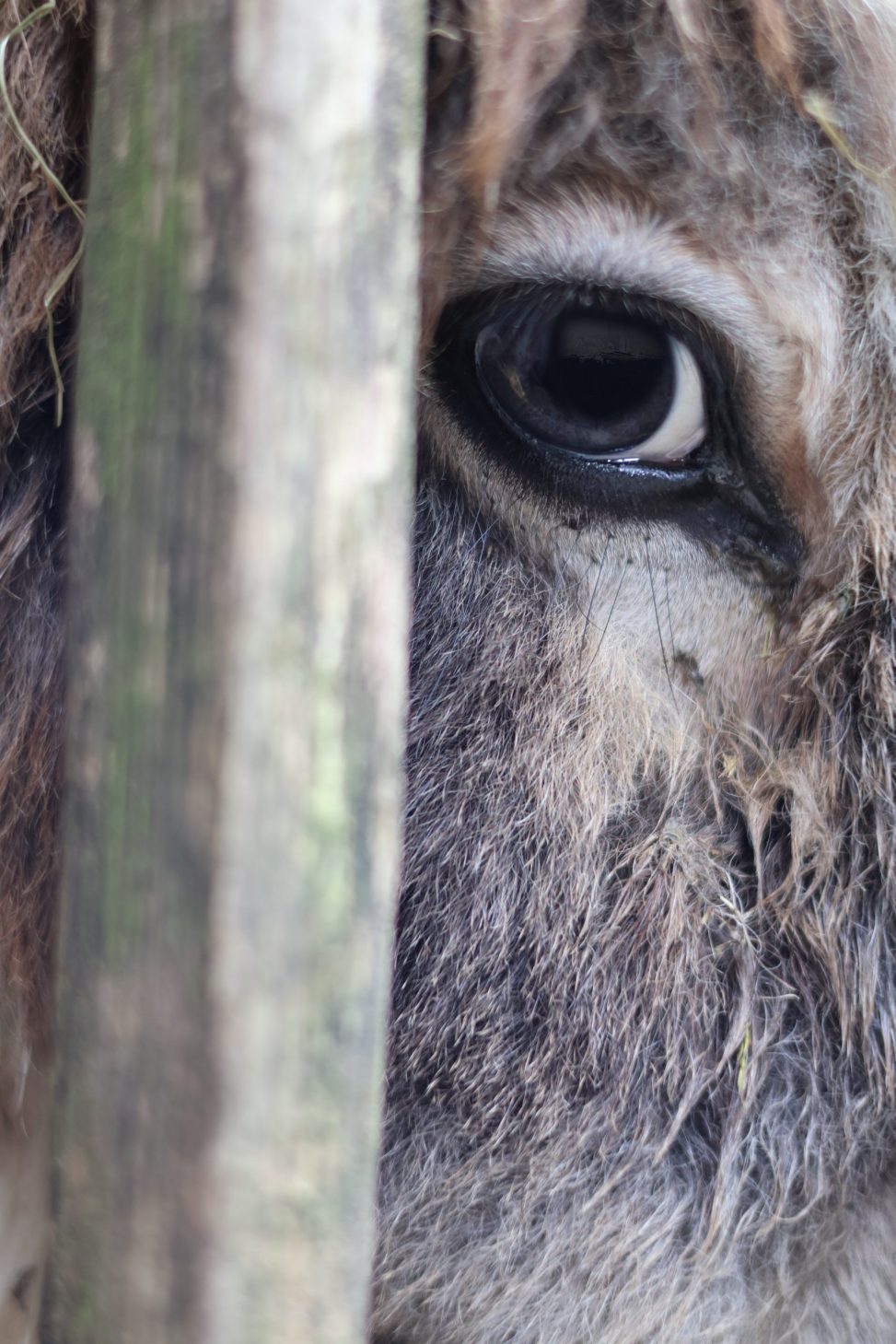
In a quiet corner of the farm, a donkey stands, his gaze steady, deep, and calm. His large, dark eye reflects the world in miniature—a universe of soft, muted colors and shapes that move slowly as the sun arcs across the sky. This eye, a quiet observer, holds secrets passed down through the gentle pace of many lifetimes.
Donkeys, unlike other animals, have eyes set wide apart, almost on the sides of their heads, giving them a unique gift: an astonishing field of view. With the ability to see nearly 350 degrees around them, their vision is nearly all-encompassing, a watchful presence in the open fields. This panoramic sight means they’re able to spot both dangers and delights from almost every direction, helping them keep themselves and their companions safe.
But the eye of a donkey is more than a mere tool for survival; it’s a window into an ancient soul. In its patient stillness lies wisdom born of simplicity. A donkey does not rush or chase, nor does it worry for what’s to come. It lives in the present, a reminder that life is not a race, but a journey.
A close look reveals something remarkable: donkeys see the world differently than we do. They can detect more shades of color in low light, allowing them to navigate terrain even as dusk settles over the earth. Their depth perception is not keen, meaning they approach the world cautiously, one step at a time, testing each path carefully before taking the next. It’s a kind of quiet deliberation that speaks of caution but also of trust in each step.
Through “The Beauty in Stillness,” we see that a donkey’s eye is not just a biological wonder but a lesson in patience, awareness, and peace. It reminds us that there is wisdom in being observant, strength in taking things slowly, and beauty in seeing the world as it truly is—undistracted, unhurried, at peace with itself.
So, next time you stand beside a donkey, look closely into that calm, dark eye. You might just see yourself reflected back, invited to pause, to breathe, to let the world slow down around you. In the quiet of that gaze, you’ll find “The Beauty in Stillness” isn’t just a photograph—it’s a way of being.